
holding notes
September, the uses of hate, downplaying illness, a book recommendation

September is my favourite month and it always goes too quickly. I’ve been deep in novel revisions and feeling sick about my prose. I keep thinking of the part in Proust where Bloch calls John Ruskin ‘one of the most tedious old prosers you could find’. In my mid-twenties, when all my friends were poets, there was a lot of snark about prose-writers. Writing prose meant courting a life of fame and fortune, which meant selling out, whereas poetry meant going down with the ship of beautiful obscurity. Having since published both I am touched by the naivety of me and my friends back then, and how little we knew about the publishing industry — bliss. Anyway, I really like ‘proser’ as a pejorative and I think we should use it more.
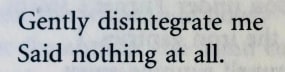
Two weekends ago I was in London to read at the launch of Effects Journal’s new issue on holes. I read a long poem I have in the issue called Sewer Theory, which started out as notes I made for an essay a few years ago and abandoned due to brain fog or pain or the fact that what I’d written was resistant to becoming an essay. It was going to be about poetry and reading and odour, about smell as opposed to taste. Taste implies distinction and refinement and an element of choice — what you put in your mouth — whereas smell is visceral and indiscriminate, it arrives whether you want it to or not. The poem became a kind of mock-manifesto of poetry as waste, orbiting a figure I am still fascinated by, Cloacina, the Roman goddess of the sewer. Here’s the opening, beginning with a line from Lisa Robertson’s The Baudelaire Fractal:
I believed that the poem must stink
But I didn’t know how to read.
I just caught the scent of something
Wafting off the page, plotless as grass.
Like bad news it could follow me anywhere.
A character insofar as a smell can fail to please.
I read for a whiff with my nostrils flared
Unbecoming as the eros of a dog
With a cartoon bone in a cartoon cloud
Above its head. It’s not how things are meant to be read.
I perform my analysis of the text
By rubbing myself on the corner of the page
Like the disaster of being an animal so
I put down the book as a sign of love.
I get my things and make my way out.

The day my boyfriend and I arrived in London was the day of the far-right demo. We got into Euston in the early evening, and there were still England flags and union jacks everywhere. I only saw groups of men, but I later read there were plenty of women and families among the ~110k in attendance. The Victoria line was packed because of the strikes, and the atmosphere was febrile, like something might kick off at any moment. A week later we went to a counter-protest against an anti-immigration demo in Glasgow. It was the first protest I have been well enough to attend in a long time. The anti-immigration side was outnumbered, their numbers reassuringly pitiful compared to the London demo. But they were still there. At one point the chant Nazi scum, off our streets started up and quickly died out. I heard a stranger comment on whether the chant was ‘sending the right message’. Then a speaker began blaring music - Chappell Roan and ABBA’s Dancing Queen - to drown out the speeches on the other side. It felt like a deliberate shift.
A few days later I started reading Hate: The Uses of a Powerful Emotion by the German writer Şeyda Kurt, which Verso sent me a proof of. During a university seminar about her previous, best-selling book, Radical Tenderness, Kurt was asked by a student if supporting a tender society also meant showing tenderness to Nazis. ‘What kind of book did I write to make someone think, even for a second, that Nazis and tenderness could even exist in the same sentence?’ Kurt asks herself. The question troubles her so deeply that it becomes the subject of her next book. She tells the student that ‘we have every reason to hate fascists. And we have to hate them.’
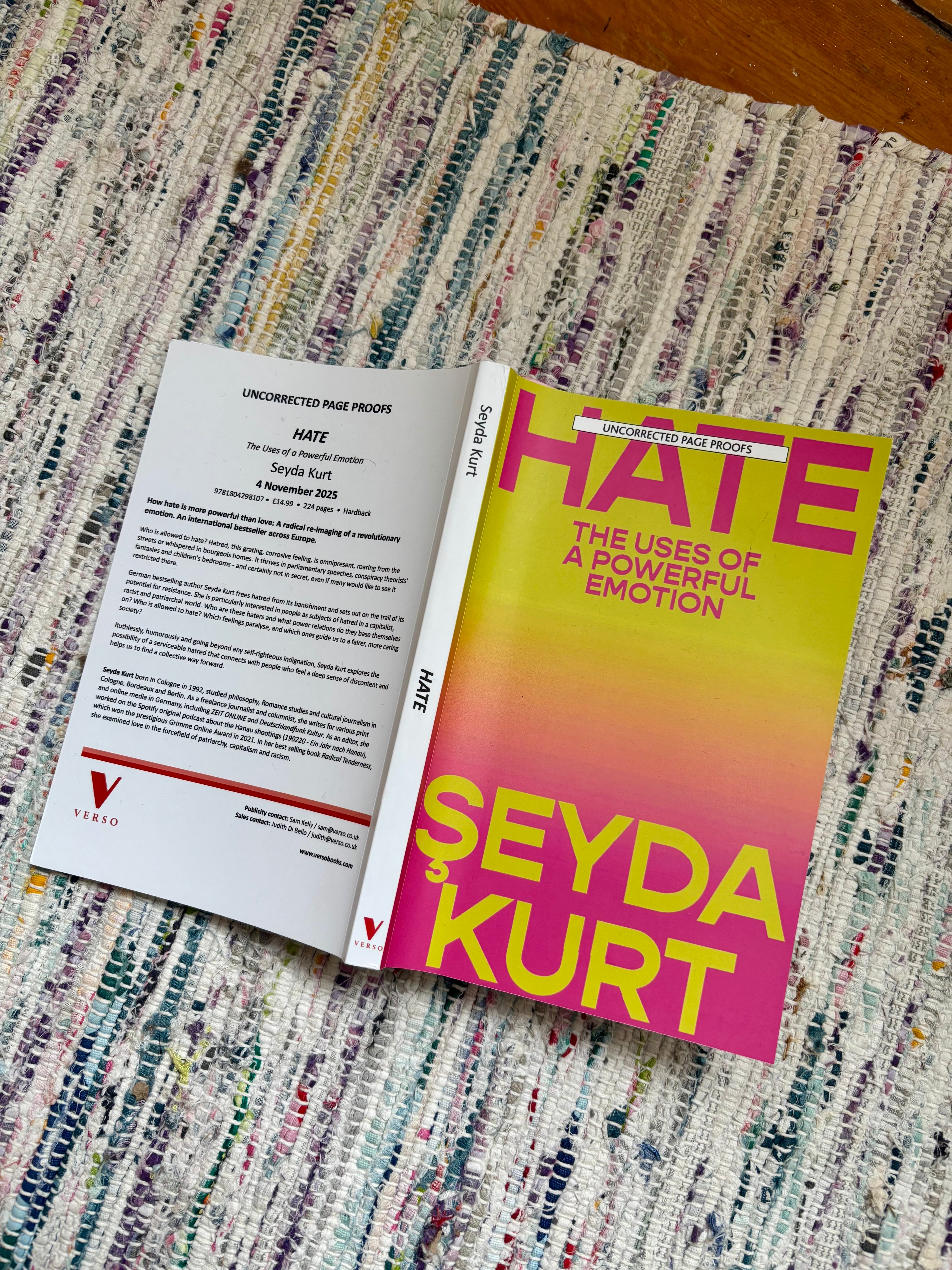
Kurt writes about being uninvited from book festivals in Germany due to her public criticism of genocide in Gaza, and of booksellers dissuading customers from buying her ‘hateful’ books. In the UK, just a few weeks after October 7, Suella Braverman was already calling the pro-Palestine demos ‘hate marches’. This rhetoric has been playing out ever since. I feel like it’s lurking in the choice to blare out ABBA and Chappell Roan instead of shouting Nazi scum, as if to prove that actually we’re on the side of love, not hate, in case it wasn’t clear. Kurt writes that she’s interested in instances where ‘hate transforms into a productive force […] a hate that attacks that which alienates and degrades people. A hate that yields tenderness.’ There’s nothing inherently innocuous about ABBA, anyway; a few days later I read that alongside Israeli drone attacks on the Freedom Flotilla docked outside Athens, Israel was also using ABBA songs to jam the ships’ radios as both a sleep deprivation tactic and to prevent contact with the coast guard.
In the same week, I spoke to someone whose significant other is in prison awaiting trial for anti-genocide protesting, held under the Terrorism Act. They showed me what an ‘email’ from prison looked like — a scanned sheet of handwriting on A4 paper, a third of which was taken up by the prison’s letterhead. Below it, the writing was cramped, awkwardly contained in a printed box which made the space even smaller. The prisoners’ access to ink is deliberately limited, I found out, so they have to decide carefully how to use it. They can draw, or they can write, but not both. And if they choose to write, they can only write so much. In the midst of what even UN officials are calling a disturbing misuse of counter-terrorism legislation, and when racist demos are not only permitted but pandered to, it’s clear that we are far past the point at which ‘sending the right message’ would have any meaningful purchase.
It’s a little under two months since I started this substack, and so far I’ve written about illness a lot less than I imagined I would. One reason for this is also why I tend not to talk about it, even with friends, unless I’m asked directly: I assume it’s boring to anyone else. Or maybe not boring, exactly, but something like the gap between how large it looms in my own life, and the extent to which I feel able to convey its hugeness, has itself become too vast. It’s easier to skirt around the edges, to use a kind of shorthand in social contexts. My boyfriend says I downplay my symptoms in conversation (which is partly why it took me so long to get any kind of diagnosis), but then seem confused when others reflect my own light-hearted tone back to me - they’re just following your cue, he says.
Two winters ago, I was spending most of my days lying on my living room floor because it was too excruciating to lift my head. Every time I did I felt something clunk out of place, pain would sear through my skull and I’d be back to square one, stuck on the floor in agony. Now I regard those days a low point, but at the time I didn’t know if I would ever improve or if everything would just keep getting worse. I didn’t know if I would ever be able to sit at a desk or in a restaurant or the pub without getting injured, or be able to write, or even hold a conversation through the miasma of pain and brain fog. Around that time my analyst said that most people who are not ill have a window of around three months of responsiveness. This usually follows someone’s diagnosis. For the first three months people are on hand: they will ask how you are, if you need anything, whether you need help getting to appointments. If you’ve broken your leg this works very well. But if you have something murkier, something chronic that waxes and wanes, with no linear track to healing, that model of responsiveness becomes unsustainable, even if it’s still needed on a physical or psychic level. My analyst rarely offers what might be construed as advice, but I am grateful for something she said around that time, that I mustn’t take take others’ fluctuating responsiveness personally. Chronic illness is a very particular experience of time that is alien until you go through it.
If my downplaying emerged in part as a strategy for being ill in relation to others, it’s been strange to recently experience this in the opposite direction — downplaying feeling better. Through going down a lot of research rabbit-holes and eventually paying to see a specialist, I got diagnosed two months ago with MCAS, a condition that was only formalised in 2007 but which I have almost definitely had since childhood. The specialist recommended a low-histamine diet to try and get the worst of the inflammation under control. Long story short, this has been life-changing in a way I am still struggling to make sense of. I knew MCAS bore some relation to EDS but I didn’t realise the extent to which it can, in some people, fuel it.1 For the first time in my life I’m sleeping, and in a lot less pain because my ligaments are no longer being eaten alive. It’s also, weirdly, been like a lowkey personality transplant. On one website I read (and felt eviscerated by) this humoral theory-esque description of the histamine intolerant individual: ‘A high histamine person might be high-strung, anxious, motivated, disciplined, hyper-vigilant, particular about their routine, thin (due to a suppressed appetite), emotionally sensitive/needing constant reassurance, “academically gifted” and an over-thinker.’
In casual conversation, it’s proved just as difficult to convey things improving as it has previously been to convey things being terrible. I’m sure there’s something comic here. I sometimes try to find correlates: I say to my asthmatic boyfriend, imagine if you lived your whole life up until now debilitated by your symptoms, which didn’t kill you but made you very unwell, but doctors said there was nothing wrong with you, until one day you found out that this condition had been discovered called asthma but you had to do a PhD’s worth of research to find out about it and figure out that you have it, but then once you start treatment for it you feel such a dramatic change it’s like the whole world has turned upside down. The problem, though, is that there aren’t correlates; MCAS isn’t asthma, and every illness is singular. I’m still far off feeling or being ‘well’ but it’s been interesting to discover that I’m feeling a little better is actually just as insufficient a phrase as I’m tired, which Rouzbeh Shadpey writes about so beautifully.
Since publishing Emily and Rouzbeh’s interviews a lot of people have been in touch to say that they read them during flares, or in bed, in pain or fatigue, and that it was exactly what they needed to read in those moments. It makes me inordinately happy to know that these have been reaching the right people. At the same time, I’ve intermittently wondered if there’s something reactionary in my fantasy of the sanatorium — an illusory retreat from the world while it burns, the tradwife-ification of chronic illness. But I think it’s more complex than that, because the sanatorium is also a vessel for collectivity — a grounds for using sickness as the basis of solidarity and organising. I love how Emily writes about the SPK’s conception of the sick as a revolutionary class, and Rouzbeh’s evocation of the ideal sanatorium as the world. I’m going to keep using the sanatorium fantasy as a model for the interviews/ writing here until it no longer feels generative — which is maybe also to say, borrowing from Dodie Bellamy, until the sick rule the world.
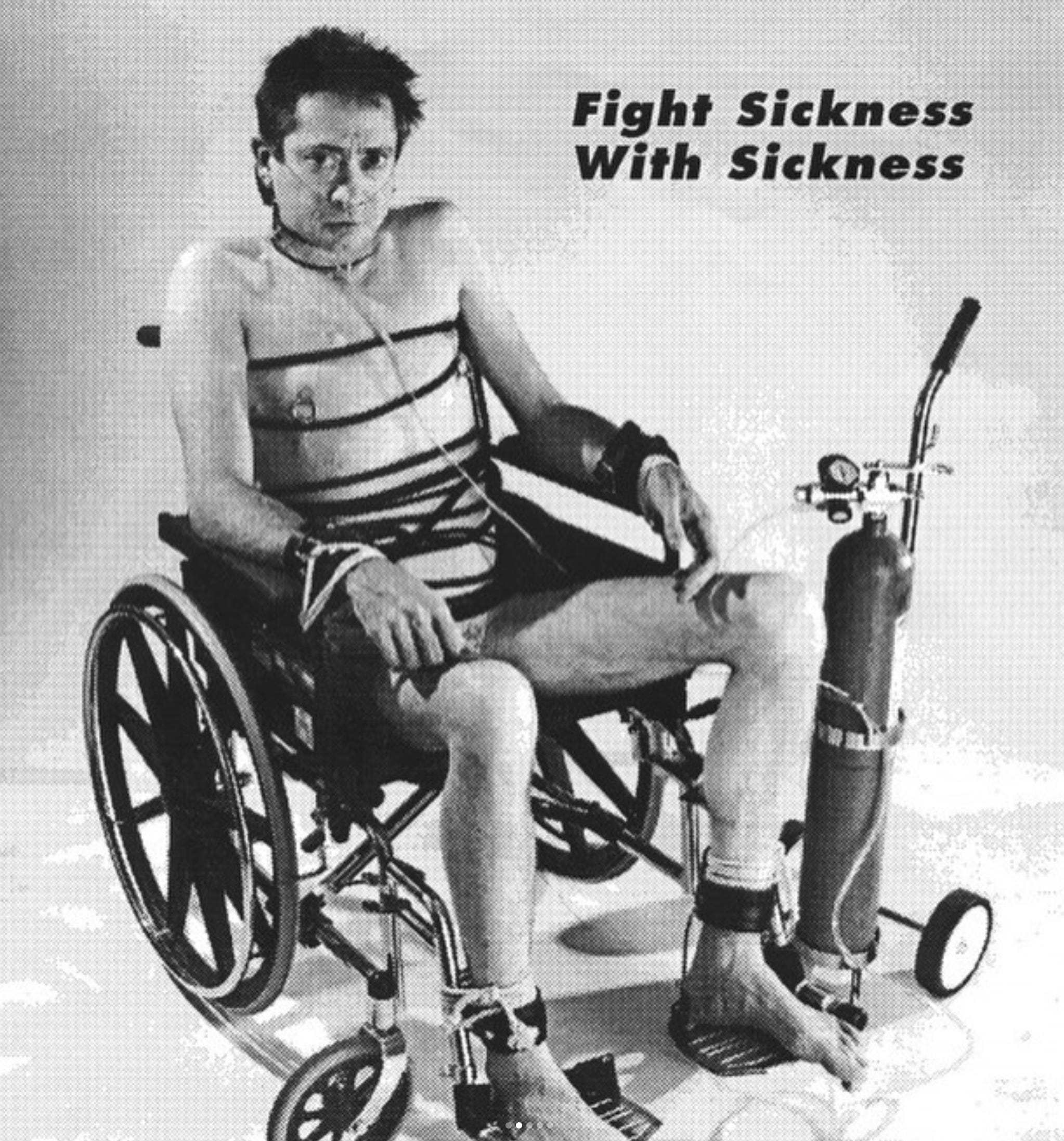
My fave, Bob Flanagan, who I wrote about for Frieze last year.
A recommendation: Nell Osborne’s novel Ghost Driver is out as of yesterday with MOIST, one of my favourite small presses. I’ve loved Nell’s poetry for a long time, and reading her novel has been one of my highlights of this year. Kate Paul wrote this great review of it for Corridor8, and there’s also an interview with Nell in the current issue of TANK. I was thinking a lot about Muriel Spark when I read it, but here’s what I ended up saying for the blurb: Ghost Driver devises a new genre of administrative horror: by turns addictively morbid, comic and discomfortingly familiar. Malory’s inner and outer worlds, like the novel’s prose, feel agonisingly poised on a knife edge – gothic in the cruellest, off-kilter sense.
Lastly — I haven’t forgotten that I promised archive things for paid subscribers, so those will be coming very soon. Beginning, most likely, with a deleted scene from my novel PAUL.
More soon x
The most up to date large-scale research on hypermobile EDS (the kind I have) suggests that immune and inflammatory involvement like MCAS have been hugely understudied as drivers of hEDS, and that hEDS might be understood less as a genetic connective tissue disorder and more as an autoimmune/auto-inflammatory disease that attacks connective tissue. If this ends up being reflected in the revised diagnostic criteria (due in 2026) it will be huge, because the mysterious genetics of hEDS (“you’re just born this way and we don’t know why”) is a large part of why doctors are still dismissive of it/ claim there is nothing to be done to help.